Why These 7 Glasaje Jewellery Designs Dazzle. This is the brief's title with the wording smoothed out.
Journal · Signature Designs
Seven pieces we keep coming back to, and why. Here is the thinking behind each design, from the gold, diamonds and gemstones they are made with to the moments they are made for.

What makes a piece of jewellery dazzle?
It is rarely about size. The pieces that stay with you are the ones where everything is in balance: the metal, the proportions, the way a stone is set, and how it all sits on skin.
Every Glasaje piece is solid 9ct gold or sterling silver. Nothing is plated, filled or coated. Our diamonds are lab-grown, our gold is recycled, and every piece is made to order in Melbourne. Below are seven designs that show what that looks like in practice, followed by a practical guide to metals, gemstones, sizing, care and gifting.
1. The Siglo Ring: one baguette diamond, nothing extra

The inspiration. The Siglo started with a shape: the long, clean rectangle of a baguette-cut stone. Where a round brilliant sparkles in every direction, a step-cut baguette reflects light in calm, mirror-like flashes. It feels architectural rather than showy.
The materials. A 0.35ct baguette-cut lab-grown diamond, EF colour and VS2 clarity, set on a polished 9ct solid gold band. The slim band keeps the focus on the stone.
How to wear it. On its own, the Siglo is quiet and considered. Stacked with a fine band such as the Barkly Stacking Ring, it reads as a modern alternative to a traditional engagement or anniversary ring. If you love the shape, the same baguette diamond appears on the Siglo Necklace and Siglo Bracelet.
2. The Satellite Necklace: three diamonds in orbit

The inspiration. Small points of light, evenly spaced, like satellites crossing a night sky. We wanted a diamond necklace that felt delicate enough for every day but still caught the eye across a room.
The materials. Three 0.06ct round lab-grown diamonds, EF VS2, set 4.5cm apart on a 44cm 9ct solid gold cable chain.
The standout detail. Spacing. Because the diamonds are spread along the chain rather than clustered at the centre, the necklace sits flat across the collarbone and moves naturally as you do.
How to wear it. Wear it alone with an open neckline, or layer it with the 45cm Hosier Necklace for a little more texture. For a matching set, add the Satellite Diamond Stud Earrings.
3. The Tawny Ring: a citrine signet with warmth

The inspiration. The signet ring is one of the oldest forms in jewellery. We wanted to soften it with colour, so we set a deep, auburn citrine into the face.
The materials. A baguette-cut natural citrine encased in a polished 9ct solid gold signet band. Because citrine is a natural gemstone, each stone varies slightly in colour. No two Tawny Rings are quite the same.
Why citrine. Citrine is a variety of quartz, so it is hard-wearing enough for a ring worn often. Its honey-to-amber tones sit beautifully against yellow gold. If you would like the colour around your neck instead, the Tawny Necklace uses the same stone on a 45cm cable chain.
4. The Baxter Ring: a statement ring for every day

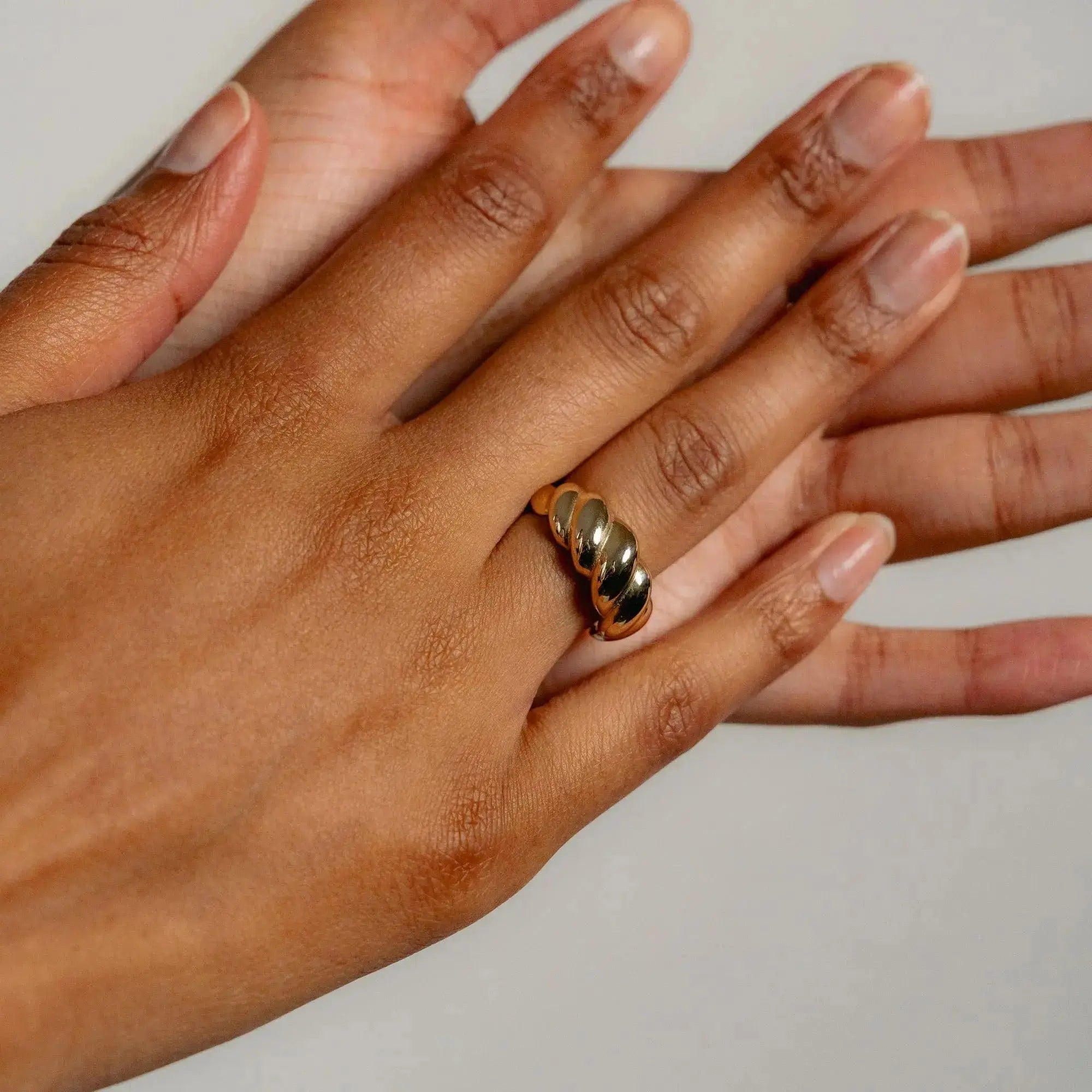
The inspiration. We wanted a ring with real presence that you could still wear to the supermarket. The answer was texture rather than stones.
The materials. A vertical ribbed pattern in 9ct solid gold, or in sterling silver.
The standout detail. The ribs catch light along every ridge, so the ring looks different from every angle. With no stones or settings to snag, it suits an active, hands-on day.
How to wear it. Wear it alone as your one bold piece, or pair it with our Signet Ring for a stack with weight to it.
5. The Lune Hoops: a crescent you can wear daily

The inspiration. A crescent moon, and the soft twisted curve of a croissant. The Lune shape began as a ring and became one of our most-worn pairs of earrings.
The materials. Croissant-style curves in 9ct solid gold or sterling silver, finished with a butterfly closure. Sold as a pair.
How to wear it. The Lune Hoops have enough shape to wear on their own. If you have a second piercing, add a Satellite Stud above for a simple, considered ear. To carry the curve through, the Lune Ring uses the same form.
6. The Gabriel Huggies: the pair you forget you are wearing

The inspiration. Every jewellery box needs a pair that goes everywhere. The Gabriel is that pair: small, close to the ear and polished.
The materials. 7mm round huggies in 9ct solid gold or sterling silver. Sold as a pair.
The standout detail. Proportion. At 7mm, the Gabriel sits snugly against the lobe, so it looks right with a T-shirt and just as right with an evening dress.
7. The Figaro Chain Bracelet: a classic link, made to last

The inspiration. The figaro chain has been around for generations, and there is a reason it keeps coming back. Its rhythm of long and short links is simple and instantly recognisable.
The materials. Alternating 4mm and 2mm links in 9ct solid gold, available in 14cm, 16cm, 18cm and 20cm lengths.
How to wear it. On its own, it is an easy everyday bracelet. Paired with the Siglo Bracelet, the plain links balance the single diamond.
View the Figaro Chain Bracelet
The seven designs at a glance
| Design | Metal | Stone | Wear it for |
|---|---|---|---|
| Siglo Ring | 9ct solid gold | 0.35ct baguette lab-grown diamond | Anniversaries, milestones, everyday |
| Satellite Necklace | 9ct solid gold | Three 0.06ct round lab-grown diamonds | Everyday, weddings, gifting |
| Tawny Ring | 9ct solid gold | Baguette-cut natural citrine | A signature piece with colour |
| Baxter Ring | 9ct solid gold or sterling silver | None | Everyday statement |
| Lune Hoops | 9ct solid gold or sterling silver | None | Day to evening |
| Gabriel Huggies | 9ct solid gold or sterling silver | None | Every single day |
| Figaro Chain Bracelet | 9ct solid gold | None | Everyday, stacking |
How do I choose the right metal for durability and budget?
The metal decides how a piece looks, how it wears and how long it lasts. Here is how the most common options compare.
| Metal | What it is | How it wears |
|---|---|---|
| 9ct solid gold Glasaje | 37.5% pure gold, alloyed for strength. Hallmark 375. | Hard-wearing and ideal for everyday. Gold all the way through, so there is no layer to wear off. |
| Sterling silver Glasaje | 92.5% pure silver. Hallmark 925. | Softer than gold and tarnishes naturally over time, but polishes back easily. A lower price point for solid metal. |
| 14ct and 18ct gold | 58.5% and 75% pure gold. Hallmarks 585 and 750. | Richer colour, higher cost. 18ct is softer and marks more easily. |
| Platinum | A dense, naturally white metal, usually around 95% pure. Hallmark 950. | Very durable and heavy, with a much higher price than gold. |
| Gold vermeil | A layer of gold over a sterling silver base. | Looks like gold at first. The layer wears thin with regular use. |
| Gold plated | A very thin layer of gold over a base metal such as brass. | The most affordable, but the plating can fade, chip or turn skin green. |
A quick note on spelling: in the United States, gold purity is written as karat (9k, 14k, 18k). In Australia and the UK we use carat (9ct, 14ct, 18ct). They mean the same thing. Confusingly, carat is also the unit used to weigh diamonds and gemstones, which is why the Siglo Ring is 9ct gold with a 0.35ct diamond.
Diamonds and gemstones, explained simply
Lab-grown diamonds are real diamonds. They have the same chemical makeup, hardness and sparkle as mined diamonds. The difference is where they form: in a controlled environment rather than deep underground. We choose them because they avoid the environmental cost of mining.
Colour and clarity. Our diamonds are specified as EF colour and VS2 clarity. EF sits near the top of the colour scale, so the stones look bright and white. VS2 means any inclusions are very small and hard to see without magnification.
Gemstones. Citrine, the stone in our Tawny pieces, is a natural yellow-to-amber quartz. Natural gemstones vary slightly from stone to stone, which is part of their character.
Settings. The setting is the metal that holds a stone in place. A good setting protects the stone, sits comfortably and lets light in. Low, smooth settings suit everyday rings and earrings because they are less likely to catch on clothing. Whatever the setting style, it is worth checking now and then that the stone still sits firmly.
Hallmarks. Hallmarks are small stamps that show metal purity: 375 for 9ct gold, 585 for 14ct, 750 for 18ct, 925 for sterling silver and 950 for platinum. You will usually find them inside a ring band, on a clasp or on a small tag. A hallmark is a useful sign, but always buy from a jeweller who also states the metal clearly in writing.
How to spot fakes online. Look for specifics. A trustworthy jeweller tells you the metal and its purity, the stone type, cut, size and quality, and where the piece is made. Be wary of words like "gold tone" or "gold finish", which usually mean plated. A cubic zirconia or moissanite is not a diamond, even if it sparkles like one. If a listing is vague, ask.
How do I find the right size before buying online?
Rings. Our rings come in Australian and UK sizes from J to U, in half sizes. Quarter sizes are available on request. If you are unsure, order our complimentary ring sizer. Measure at the end of the day, when fingers are at their largest, and size up slightly for wide bands like the Baxter.
Bracelets. Measure your wrist snugly with a soft tape, then add 1 to 2cm for a comfortable fit. Our bracelets come in 14cm, 16cm, 18cm and 20cm.
Necklaces. A 44 to 45cm chain, like the Satellite and Hosier, sits around the collarbone on most people. When layering, leave 2 to 5cm between lengths so each chain has room. The Lariat Necklace, with its 10cm drop, adds natural length to a layered look.
Care and maintenance at home
Solid gold is easy to live with, but a little care and maintenance keeps rings, earrings, necklaces and bracelets looking their best for years.
Gold. Clean with warm water, a drop of mild dish soap and a soft toothbrush. Rinse and dry with a lint-free cloth. Take rings off for the gym, gardening and cleaning, and keep jewellery away from chlorine and harsh chemicals.
Sterling silver. Silver tarnishes naturally when it meets air and moisture. Wearing it often actually helps. A silver polishing cloth brings back the shine in seconds.
Diamonds and gemstones. Lotions and natural skin oils dull a stone's sparkle. Clean around settings gently with the same soap and soft brush. Avoid harsh chemicals and sudden temperature changes with citrine.
Storage. Store pieces separately in a soft pouch or lined box so harder stones do not scratch softer metals and chains do not tangle.
Servicing, insurance and valuation. Check your settings now and then. If a stone feels loose or a clasp no longer closes firmly, stop wearing the piece and contact us. Every Glasaje piece is backed by our 12-month warranty. For insurance, keep your order confirmation and product details, which list the metal, stone and specifications your insurer or valuer will ask for.
How do I layer jewellery without it looking cluttered?
- Start with one anchor. Choose your main piece first, such as the Satellite Necklace or Baxter Ring, and build quietly around it.
- Vary lengths and widths. Pair a fine chain with a slightly heavier one, and keep a clear gap between necklace lengths.
- Mix metals with intent. Gold and silver together can look deliberate. Repeat each metal at least twice so the mix feels planned.
- Leave some space. Two or three rings across a hand often reads better than five on one finger.
- Build the ear in steps. A huggie or hoop in the first piercing and a small stud above is a simple, balanced start.
Layering, stacking and pared-back pieces are what we see people reaching for most right now. The good news is that these styles are built on classic shapes, so they will not date.
Buying jewellery as a gift
Jewellery marks a moment: a birthday, a wedding, an anniversary, a promotion. A few things make gifting easier.
- Plan for production time. Every piece is made to order in Melbourne. Rings take 5 to 10 business days and earrings, necklaces and bracelets take 15 to 20 business days, before shipping.
- Not sure of a ring size? Earrings, necklaces and bracelets are easier to gift. Ring resizing is also available within 30 days of delivery.
- Let them choose. A Glasaje online gift voucher is delivered digitally and never needs a size.
- Peace of mind. Returns and exchanges are accepted within 30 days of delivery, and shipping is free Australia-wide, insured with Australia Post. Afterpay and Zip are available at checkout.
What Glasaje uses
All Glasaje gold jewellery is crafted in solid 9ct gold, and our silver pieces in solid sterling silver. We use recycled gold and lab-grown diamonds, and every piece is made to order in Melbourne. We are certified Australian Made and Owned, and every piece is backed by our 12-month warranty.
Frequently asked questions about Glasaje jewellery
Is 9ct gold good for everyday wear?
Yes. 9ct gold contains 37.5% pure gold, with the rest made up of other metals that add strength. It is harder than 18ct gold, so it handles daily wear well. Because it is solid gold, it will not fade, flake or wear through.
Are lab-grown diamonds real diamonds?
Yes. Lab-grown diamonds are chemically, physically and optically the same as mined diamonds. They are not simulants like cubic zirconia. Glasaje uses lab-grown diamonds specified as EF colour and VS2 clarity.
What is the difference between gold vermeil, gold plated and solid gold?
Gold plated jewellery has a very thin gold layer over a base metal. Gold vermeil has a gold layer over sterling silver. Both layers wear away with time. Solid gold is gold all the way through, so it lasts.
What if I have sensitive skin?
Solid gold and sterling silver are generally better tolerated than plated or base metal jewellery, which is a common cause of irritation. Everyone reacts differently, so if you have a known metal sensitivity, get in touch before ordering and we will talk you through the alloys we use.
How do I find my ring size?
Order our complimentary ring sizer, which reads in Australian and UK whole and half sizes. Measure at the end of the day, and if you fall between sizes, choose the larger one.
How do I clean gold jewellery at home?
Soak it briefly in warm water with a drop of mild dish soap, brush gently with a soft toothbrush, rinse and pat dry with a lint-free cloth. Avoid chlorine, bleach and abrasive cleaners.