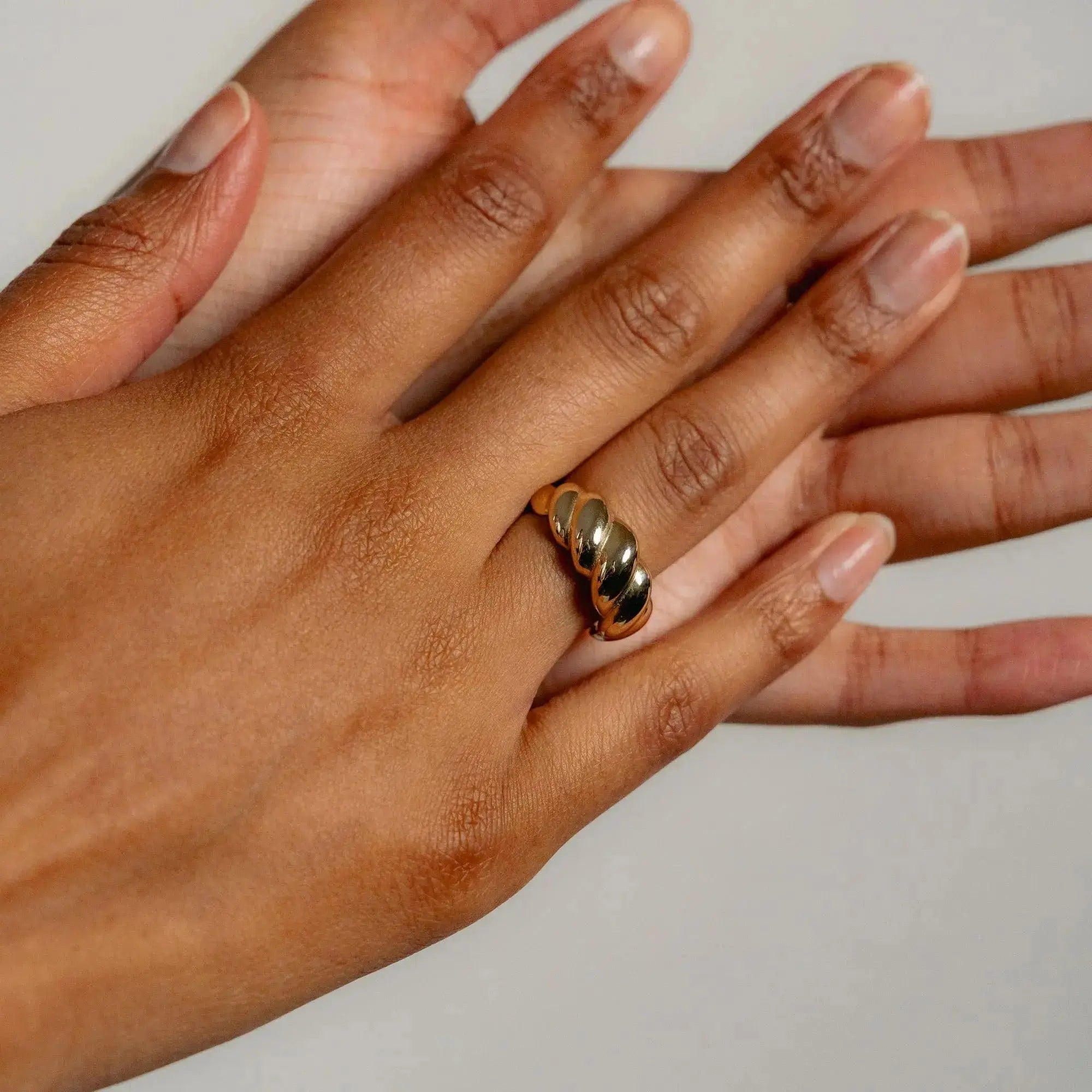
How to stack rings: a guide to ring stacking in Australia
Journal · Styling
Ring stacking is one of the most personal ways to wear jewellery. A few simple rules make the difference between a look that feels intentional and one that feels cluttered.

Start with an anchor ring
Every good stack starts with one statement piece. This is your anchor, the ring that gives the rest of the stack its direction. At Glasaje, the Signet Ring, Dome Ring, or Baxter Ring all work well as anchors. Something with presence and a defined silhouette.
Build from the anchor outward. Add thinner or simpler bands on either side, rather than placing multiple statement rings together.
Mix textures, not widths
The most successful stacks pair rings of similar widths with contrasting textures. A smooth dome next to a textured wave. A plain band next to a sculptural piece. Try the Ripple Stacking Ring alongside the Barkly Band, two minimal bands with different surface textures that work together without competing.
How many rings to stack
Three is the most reliable number for most fingers. One anchor, one band on each side. You can go further, and four or five rings on a single finger can look deliberate, but the more rings you add, the thinner each one should be to avoid bulk.
You can also spread the stack across multiple fingers rather than loading one. One ring per finger across three or four fingers often reads as more sophisticated than five rings on one finger.
Which fingers to stack on
There are no rules here, but some fingers are more practical than others. The middle and ring fingers are the most common for stacking. Index finger rings make a deliberate statement. Pinky rings work well with a single, slimmer band. Mixing stack fingers is part of what makes the look personal.
Keep metals consistent
Within a single hand, staying in one metal, all solid 9ct gold or all sterling silver, gives a more cohesive result. Mixing metals across hands is a considered choice that works when done intentionally. Mixing metals on the same hand is harder to execute without it looking accidental.
Sizing a stack
Stacked rings sit against each other, so fit matters more than it does for a single band. Our rings are made in Australian and UK letter sizes from J to U, in quarter sizes, which helps here: you can order the exact size rather than rounding. For a stack, a snug fit stops rings spinning against one another. Check the ring size guide before you order.
When to stop
If you are not sure whether to add one more ring, do not. Step back, look at both hands together, and remove the last piece you put on. More often than not the look improves. The goal is a stack that feels like it was always there, not one that announces itself.
Building a Glasaje ring stack
Some pairings that work well together from the Glasaje collection:
- Dome Ring plus Ripple Stacking Ring plus Barkly Band. Bold centre, minimal sides.
- Signet Ring plus Tawny Ring in citrine plus a thin band. Classic with a colour accent.
- Lune Ring plus Ripple Stacking Ring. Two minimal pieces, different shapes.
All Glasaje rings are solid 9ct gold or sterling silver, made to order in Melbourne, and available in Australian and UK sizes J to U including quarter sizes. If you need a size outside that range, get in touch.
Frequently asked questions about ring stacking
How many rings should you stack?
Three rings is the most common and reliable number for a stacked look. One anchor ring with one band on either side. You can add more with very thin bands, or spread rings across multiple fingers rather than loading one.
Which finger is best for stacking rings?
The middle and ring fingers are the most common choices for stacking. Index finger rings make a deliberate statement. There are no fixed rules, and spreading rings across several fingers can look more intentional than concentrating them all on one.
Can you stack different ring styles?
Yes. Mixing styles, such as a dome with a band or a sculptural ring with a plain ring, is what makes a stack personal. The key is to keep metal consistent and let one ring do the talking as the anchor piece.
What are stacking rings?
Stacking rings are rings designed to be worn together on the same finger. They are typically thinner and simpler in profile than statement rings, so they can sit alongside other pieces without overwhelming. At Glasaje, the Ripple, Barkly, and Tawny Ring are designed with stacking in mind.
How do you stop stacked rings from spinning?
Rings spin when they are slightly too large for the finger. The fix is sizing correctly. Because we make quarter sizes from J to U, you can usually order the exact fit rather than rounding. Use our ring size guide to find your letter.